
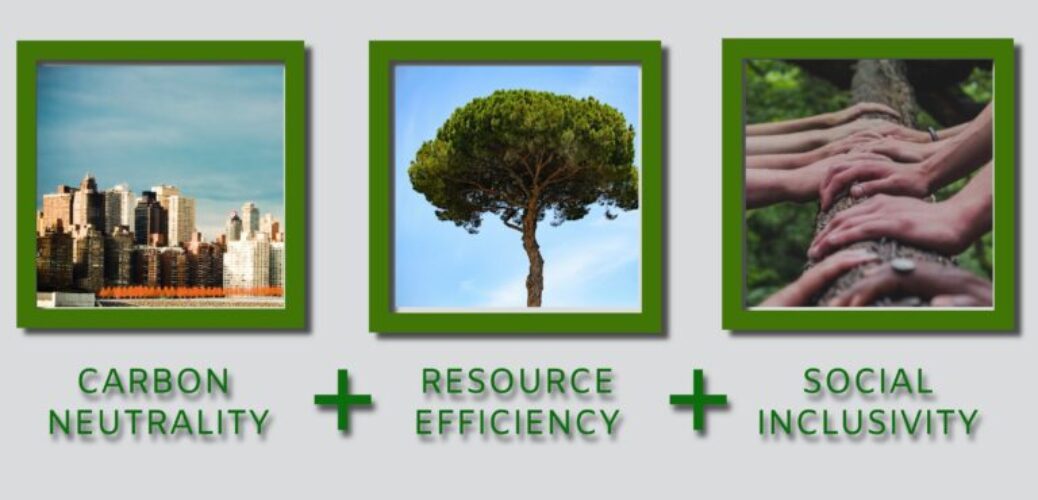
Green Economy

The rapid consumption of the Earth’s natural resources, driven by the needs of a growing population (such as food, clothing, housing) as well as the needs to supply the raw materials of modern industry (gas, oil, minerals) has caused concern among scientists and environmentalists alike. According to the Food and Agriculture Organization of the United Nations (FAOUN) in 2020 3 billion people could not afford the cheapest healthy diet, and 13% of the world population is obese2. There is a need to produce more nutritious food that would be accessible and affordable to all, and to produce it in a more sustainable way that reduces greenhouse emissions and ensure adequate supply but not to the detriment of future food supply. For example, according to the FAOUN we have overfished and overexploited 80% of our world fish stocks3. They recommend we also reduce pre- and post-harvest loss and waste as important vehicles of sustainability, as over a third of fish and seafood products are lost or wasted.4 Modern industry must also look to reducing their carbon footprint as well. According to the United States Environmental Protection Agency, Industry accounts for 24% of 2020 greenhouse gas emissions.5 In a Forbes magazine article, Guneet Bedi of the Forbes Business Development Council states “Sustainability initiatives often look terrible on paper at the onset. It costs money to build a green infrastructure or decarbonize as much as possible, for example. It’s a hefty investment, which can be difficult for decision-makers to embrace.”
“However, getting through this transition period where revenue dips and costs increase…in time will translate to steadier profits and greater efficiencies.”6
On September 28 and 29 of this year, prominent speakers, experts, thought leaders and decision makers of international institutions and organizations will come together at the Dubai World Trade Center for the eighth World Green Economy Summit (WGES). They will continue to discuss the means and methods for a sustainable future.7
These methods were first established and published in the United Nations Environment Program (UNEP) Annual Report in 2011 and elaborated in the Green Industrial Policy Report in 2017. The report explains the concepts and frameworks for a green environment, as well as documents the efforts of member nations in creating a sustainable economy.
Written with the objective of sustainable development in mind, the report nevertheless recognizes the importance of creating wealth, even more so for the developing nations. 767 million people lived on less than US$ 1.90 a day, and 1.9 billion people in the developing world still had less than US$ 3.10 a day in 2013.8 The report also notes that economic development in the past has been achieved at the cost of severe overexploitation of natural resources and subsequent environmental damage. Conservationists and Industrialists are on opposing sides with no middle ground. Industrialists see successful economic development only possible using historically proven methods (they will worry about the environment later), while Conservationists place too much emphasis on environment to the detriment of development and prosperity.
The report traces the historical approach to development. First World countries developed by having an efficient agriculture, then expanded their local industrial production. Their labor from farms moved into manufacturing. This Increased wages and prosperity. Thus, agriculture and manufacturing achieved and sustained a relatively high level of production. As production became more automated and less labor-intensive, people then moved to the service industry and more specialized industries, again increasing wages and prosperity. This is not the case today for developing countries. Economists say developing countries are experiencing a unique phenomenon they call premature deindustrialization. Countries are expanding and moving labor to other industries even before Agriculture and Manufacturing are at satisfactory production and efficiency levels. This trend makes the country’s future economic growth and prosperity doubtful, as manufacturing and modern services are the drivers of diversification and growth. This is further exacerbated by First World efficiently produced goods dominating the market with their cheap prices.
The way forward then is for countries to recognize the necessity of agriculture and manufacturing, manage development and change in a structured way, take advantage of modern technologies and practices to accelerate development, and encourage skill building and entrepreneurship among its people to create prosperity in a socially inclusive way.
But the present path to economic growth is now unsustainable. Natural resources have been overexploited; pollutants have been accumulating. There is increasing water scarcity and decreasing soil quality. Scientists are warning that the earth’s ecology will reach a tipping point where natural processes that restore depleted systems will be unable to restore equilibrium.
“Radically new techno-institutional systems are needed to decouple economic development and human well-being from resource depletion and waste production.” – UN Green Industrial Policy Report, 2017.
Nations need to implement what they call a Green Industry Policy. Similar in some ways to existing industrial policies, where the focus is on high productivity, societal inclusion, and general prosperity, green industrial policy considers also increasing environmental sustainability.
Governments need to see prosperity at the cost of environmental damage a policy failure and correct the market to reflect this. They should create polices favoring and accelerating green technologies, while discouraging investment and restricting growth in traditional carbon emitting ones.
They should officially recognize technologies that are good and those that are bad for the environment, steering investments towards sustainable development. Importantly, these initiatives must have a sense of the urgency of change as it must make people aware we face a coming catastrophic tipping point.
“In the long term, there is no trade-off among social, economic and environmental objectives: there is no human development or economic success on an uninhabitable planet.” – UN Green Industrial Policy Report, 2017.
Some of these new green technologies would have long time horizons with some degree of uncertainty that would discourage investors. Government should assure investors and such ventures with incentives such as preferential tariffs and so on.
There is also a need for closer policy integration and coordination, as green initiatives should not conflict with each other, such as building a wind farm that damages a coral reef.
Moreover, Governments should be aware that working for sustainability of its natural resources may not be in its national interests but will do so for the common good of its neighbors.
In the 21st century, concerns over the Environment have moved to the forefront of the issues facing Governments and Society. Policies and business practices that emphasize sustainability, supported by continuous developments in science and technologies, are being developed and practiced today by the industries of most nations of the world. It is heartening to see the different Nations coming and working together towards the common goal of sustainability. It gives the ordinary person courage to face the future and gives hope to our children and the generations that will come after us. We are no longer the devourers, but the caretakers of our Planet Earth.
Robert Suter
Contributor
REFERENCES:
https://www.adamsmith.org/adam-smith-quotes/
The State of Food Security and Nutrition in the World 2020 – YouTube
https://www.huffpost.com/entry/sustainable-fish-do-not-exist_b_11632622
https://www.fao.org/3/ca9229en/online/ca9229en.html#chapter-Key_message
https://www.epa.gov/ghgemissions/sources-greenhouse-gas-emissions
https://www.forbes.com/sites/forbesbusinessdevelopmentcouncil/2021/11/09/succeeding-in-the-modern-era-of-industrial-sustainability/
https://www.msn.com/en-ae/money/news/world-green-economy-summit-to-focus-on-energy-finance-food-security/
Green Industrial Policy | UNEP – UN Environment Programme,2
https://www.unep.org/about-un-environment
Annual Report 2021 | UNEP – UN Environment Programme